Insight · Tank container · Dangerous goods
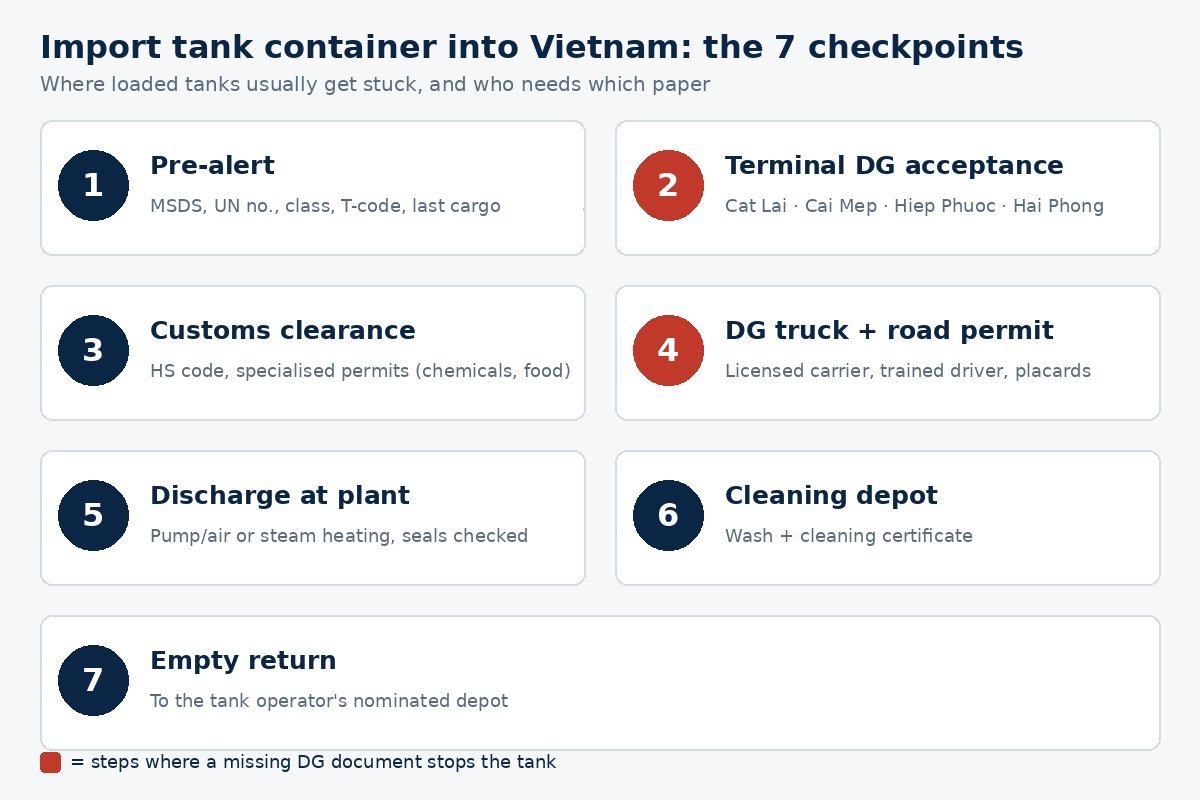
A loaded tank container that lands in Vietnam without a licensed DG truck waiting can sit at the terminal and burn storage days. This guide covers what has to be ready before the vessel arrives: tank specs, terminal handling charges for tanks, the road permit, and where the empty goes for cleaning.
Written by our operations team in Ho Chi Minh City.
Short answer: a tank container moves through Vietnam like any other box at sea, but on land it is a different job. If the cargo is dangerous goods, the truck needs a DG transport permit and a trained driver.
The terminal must accept the class, and the empty must be cleaned before it goes back to the tank operator. Get those three right and an ISO tank is one of the cleanest ways to move liquid chemicals and food liquids into or out of Vietnam.
An ISO tank container is a stainless steel pressure vessel fixed inside a 20 ft steel frame. The frame has the same corner castings as a dry box, so the tank stacks on ships, sits on a normal container chassis and is lifted by the same terminal equipment.
In Vietnam you will hear several names for it: ISO tank, tank container, “cont bon” and, in some chemical trades, “container xitec”. They all mean the same unit.
The people who book tank containers into and out of Vietnam are mostly:
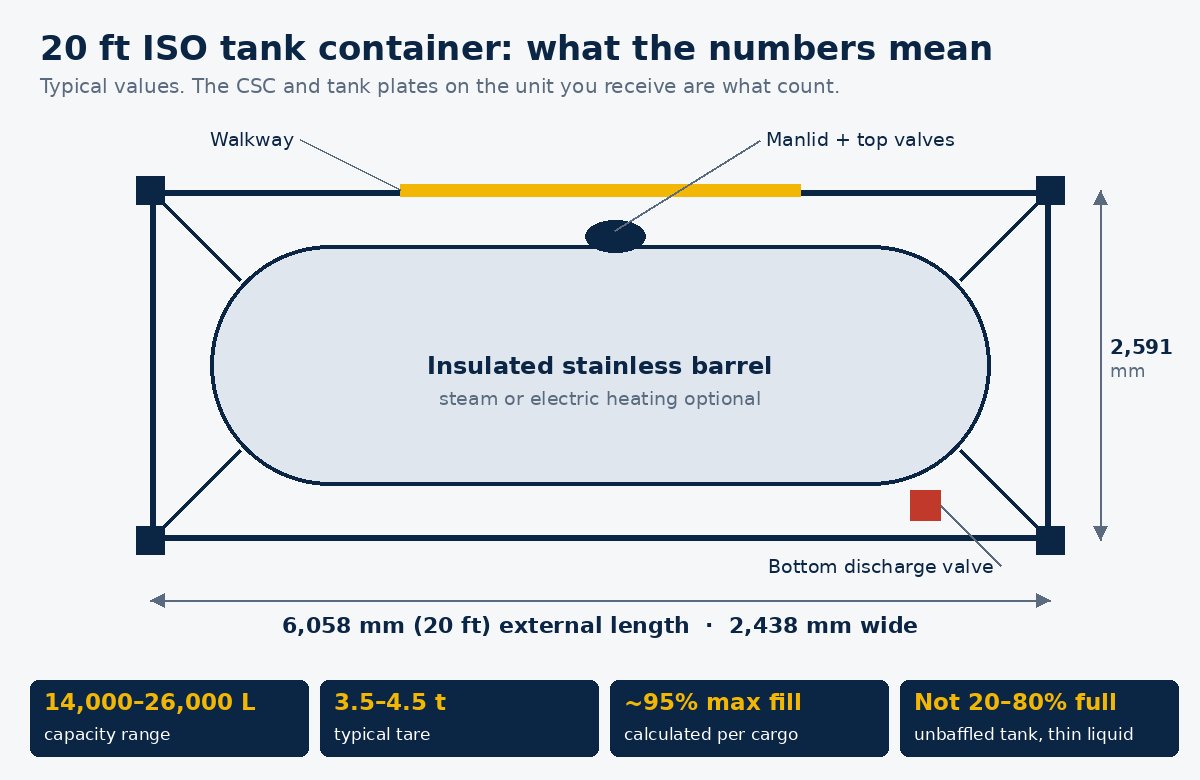
Almost all ISO tank containers in trade are 20 ft. A 40 ft tank exists but is rare, because a full 40′ barrel of liquid would be far too heavy for the road. Numbers vary by builder and tank type, so treat the table as typical values.
| Item | 20′ ISO tank (typical) | Why it matters |
|---|---|---|
| External frame | 6,058 × 2,438 × 2,591 mm | Same footprint as a 20′ dry box; no OOG approval needed |
| Barrel capacity | 14,000–26,000 L | Heavy cargo (high density) goes in smaller tanks |
| Tare weight | about 3,500–4,500 kg | Insulation and heating add weight |
| Max gross | on the CSC plate, up to 36,000 kg on modern tanks | Road limits in Vietnam may be lower than the sea limit |
| Fill level | max fill calculated per cargo, around 95% | Liquid expands with heat; a full tank can burst its relief valve |
| Surge rule | not between 20% and 80% full | Applies to thin liquids in tanks without baffles |
The two fill rules come from the portable tank provisions of the IMDG Code. A part-filled tank lets a thin liquid slosh, and the surge can push a truck off line on a bend. That is why low-viscosity cargo in an unbaffled tank must be either above 80% or below 20%.
Each tank carries a T-code (portable tank instruction) on its plate. The cargo’s entry in the dangerous goods list says the minimum T-code allowed. A higher-rated tank can carry lower-rated cargo, never the reverse.
| T-code | Typical use | Examples |
|---|---|---|
| T1–T10 | Lower-hazard liquids | Many solvents, oils, some resins |
| T11 | The common chemical tank, about 4 bar | Most industrial chemicals |
| T14 | Corrosive or more hazardous liquids | Some acids |
| T50 | Liquefied gases under pressure | LPG, ammonia, refrigerant gases |
| T75 | Refrigerated liquefied (cryogenic) gases | Liquid nitrogen, LNG |
Food-grade tanks are a separate world: they are dedicated to food and should not have carried chemicals. Ask the tank operator for the last three cargoes and the cleaning certificate before you load anything edible.
Shipping something that does not fit a standard box? Compare with our flat rack container dimensions and open top container guides.
A tank container is an in-gauge 20′ box, so it goes through the normal container terminals. The questions are which dangerous goods classes the terminal will store, and whether it asks for direct delivery (hook-to-truck) for some classes. Rules differ by terminal and change, so we confirm them per booking.
| Port area | Typical tank traffic | Land-side note |
|---|---|---|
| Cat Lai (HCMC) | Intra-Asia services, chemicals and food liquids for the HCMC region | Inner-city truck hours apply; plan DG trucks around them |
| Cai Mep (Ba Ria–Vung Tau area) | Mainline services to Europe and the US | Closest deep-water port for the Phu My industrial area |
| Hiep Phuoc / Nhon Trach | Smaller terminals on the river south and east of HCMC | Short haul to Nhon Trach and Long An industrial zones |
| Hai Phong | The north: Hai Phong, Hai Duong, Bac Ninh, Hanoi | Plan DG trucks for the full inland haul to Hanoi or Bac Ninh |
For a wider view of each terminal, see our Vietnam ports guide.
Most carriers put ISO tanks in the same terminal handling charge (THC) band as reefer, open top and flat rack, which is higher than a dry box. Some lines in the intra-Asia trade charge tanks the same as dry. Below are three carriers’ published tariffs from our local charges database, in VND per container, excluding VAT.
| Carrier (effective date) | 20′ dry | 20′ ISO tank | 40′ dry | 40′ ISO tank |
|---|---|---|---|---|
| ONE (1 Apr 2026) | 3,000,000 | 4,200,000 | 4,800,000 | 6,000,000 |
| CMA CGM (1 May 2026, non-US cargo) | 3,355,000 | 4,125,000 | 5,170,000 | 6,655,000 |
| Evergreen (15 Feb 2026, prepaid export / collect import) | 3,375,000 | 5,210,000 | 5,200,000 | 7,240,000 |
So on these three lines a 20′ tank pays roughly 0.8–1.8 million VND more THC than a 20′ dry box. A line’s “container cleaning” fee on import is a box fee, not a wash of the barrel; the tank wash is billed by the depot.
Storage is the other cost. A loaded DG tank waiting for its truck still counts free days; see demurrage and detention in Vietnam for how free time is counted.
The sea leg follows the IMDG Code. Once the tank leaves the terminal gate, Vietnamese road rules take over, and for dangerous goods the main text is Decree 161/2024/ND-CP (in force since 1 January 2025, as amended). It sets the list of dangerous goods for road transport and the procedure for the transport permit.
What that means in practice for a loaded tank container:
Non-hazardous liquids in a tank (edible oil, syrup, many latex grades) do not need the DG permit. They move as a normal 20′ container, but the tank is heavy. We check the gross weight against the chassis and road limits before we confirm.
Send the MSDS, UN number and class, port of discharge and delivery address. We come back with the DG trucking plan, the permit status and a net rate within 2 working hours.
This is what a typical tank container enquiry looks like on our side. It came in on 2 October 2026 from a chemical distributor in the south.
Two lessons from this one. First, the permit question comes before the price, so have the carrier’s DG licence ready to show. Second, the port choice moves the truck cost: for the same warehouse the two terminals priced differently, so we quote both when the line allows.
After discharge the tank goes to a cleaning station, gets washed to suit the next cargo, and receives a cleaning certificate. Only then does the tank operator accept it back or reload it. A dirty tank returned to the wrong depot is a common source of extra charges.
The largest tank depot we know of publicly in the south is the HOYER network partner cotac in Ho Chi Minh City. In a November 2025 press release, HOYER said the depot had been expanded to hold over 1,000 tank containers and offers specialised cleaning for products such as MDI, TDI and latex.
How the cleaning step usually works:
For food-grade tanks, ask whether the depot has a food-grade wash and certificate. If not, the tank may have to travel further, and that changes the empty truck cost.
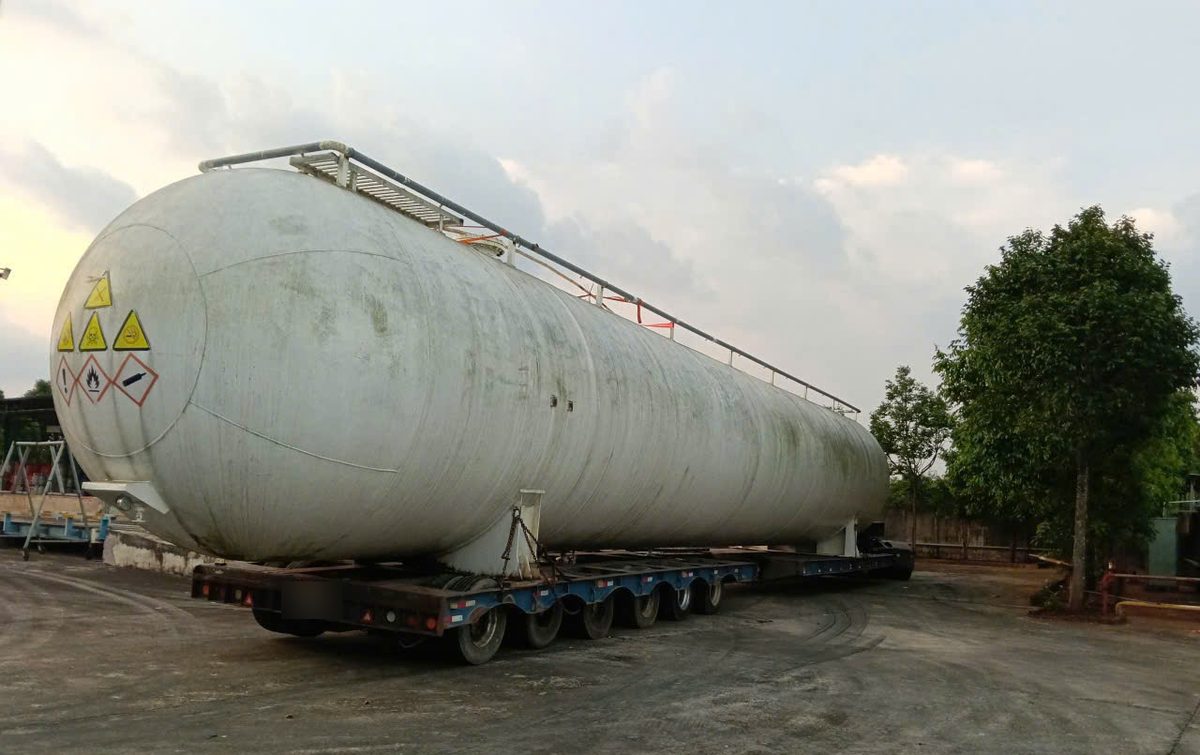
Many people who search “tank container” in Vietnam are moving the tank itself: a storage vessel, silo or process drum for a new plant. These are not ISO tanks. They are out-of-gauge (OOG) cargo and travel on flat racks, as breakbulk or on lowbed trailers.
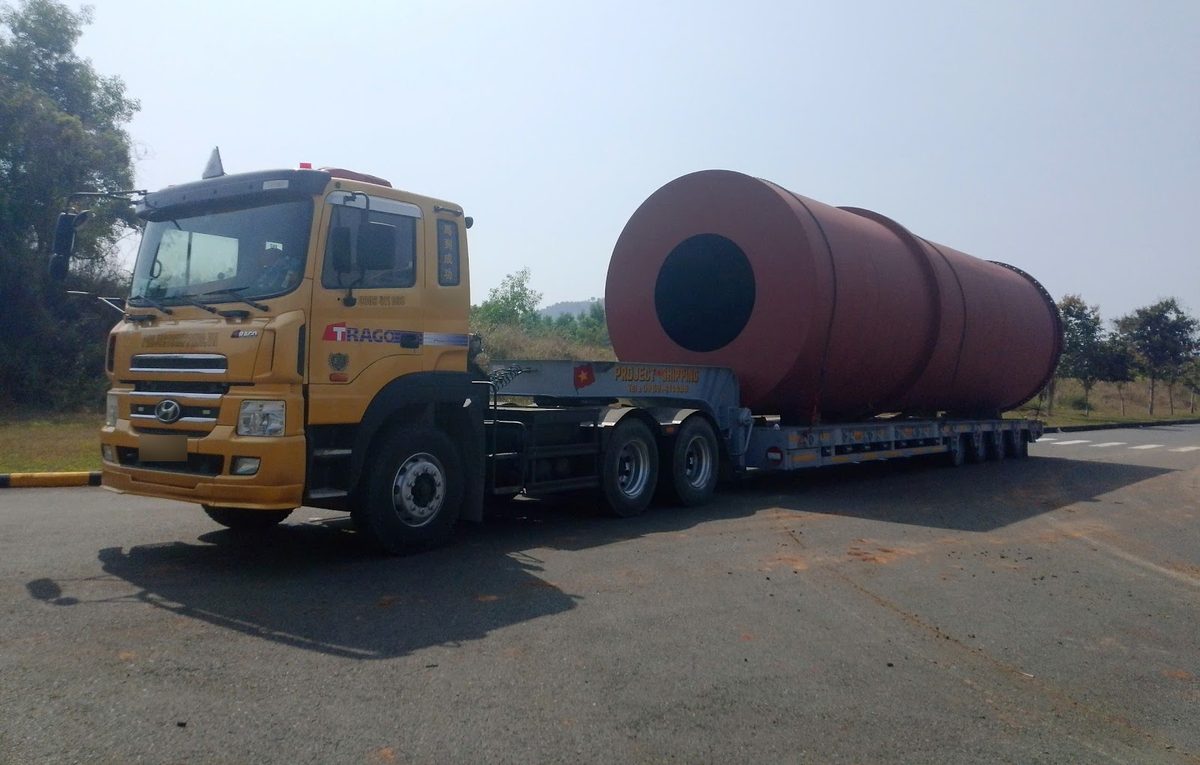
The rules for these jobs are about size, not chemistry: any load wider than 2.5 m on the road needs an oversize permit, and tall vessels need a low deck. If the vessel once held gas or chemicals, it must be empty and cleaned, or it becomes a DG job as well.
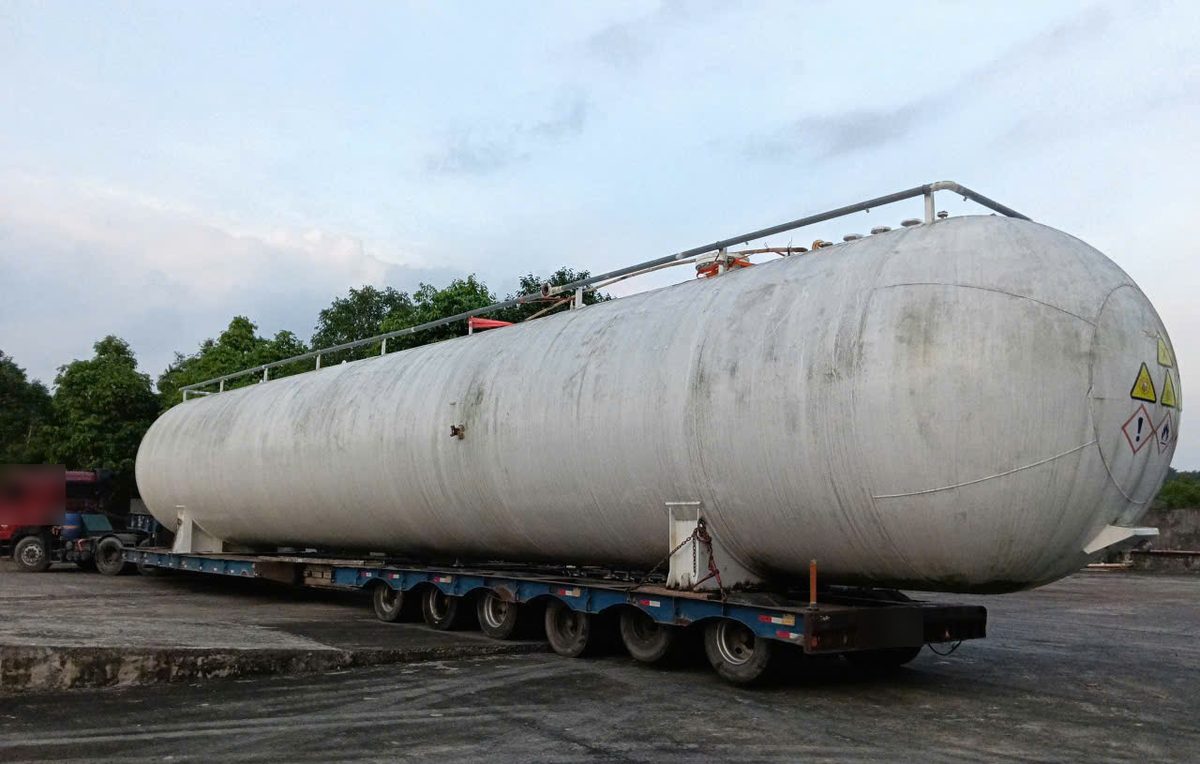
For these, start with our lowbed trailer guide and oversize permit guide.
THC, D/O, CIC and cleaning fees for 16+ carriers, with effective dates.
Local charges →Documents, HS codes and specialised permits for chemicals and machinery.
Customs guide →Tony Tuan, CEO: WhatsApp +84 909 411 668 · ceo@projectshipping.vn
Nura Tu, Overseas Department: WhatsApp +84 906 770 650 · overseas@projectshipping.vn
Calling from Vietnam: 0909 411 668
Agents: see how we work with network partners on our agents page.
Last updated: November 2026 · By Tony Tuan, CEO, Project Shipping





© 2017 – 2026 Project Shipping. Design by Thiết kế Web DC