Insight · Shipping modes · Vietnam
Ro-Ro shipping moves cargo that rolls: trucks, cranes, machinery on wheels or tracks, and heavy static pieces placed on a roll trailer. This guide covers what qualifies, which Vietnamese ports handle it, how it compares with flat rack and breakbulk, and the paperwork for vehicles and machinery.
Written by our operations team from Ro-Ro jobs through Ho Chi Minh City and Hai Phong. · Jump to the comparison table

Short answer first: if your unit can drive, be towed, or sit on a roll trailer, Ro-Ro shipping is usually the safest way to move it by sea. Nothing is lifted at the berth, so the biggest single risk of heavy cargo, the crane lift, disappears. The trade-off is fewer sailings and fewer ports than container shipping.
Ro-Ro stands for roll-on/roll-off. The vessel has a stern or quarter ramp and several internal decks, a bit like a floating car park. Cargo is driven or towed up the ramp, parked on a deck and lashed to the deck fittings.
Car carriers (PCC/PCTC vessels) are the most common Ro-Ro ships on Asian routes. Their higher decks are for cars; the main deck and the hoistable decks take trucks, buses and construction machinery. Deck height and ramp capacity decide what fits, so every unit is checked against the vessel before booking.
Ro-Ro cargo falls into two groups: units that move under their own power, and static cargo that is placed on a roll trailer (often called a Mafi) and towed on board by a terminal tractor.
| Group | Examples | What the line checks |
|---|---|---|
| Self-propelled | Trucks, tractor heads, buses, mobile cranes, concrete pump trucks | Running condition, height, length, axle loads, fuel level |
| Tracked machinery | Excavators, crawler cranes (dismantled), dozers | Track width, weight, deck protection under the tracks |
| Towable units | Trailers, mobile equipment on its own axles | Tow point, brakes, tyre condition |
| Static cargo on roll trailer | Transformers, rolls, press frames, crated machinery, amusement rides | Roll trailer capacity, lashing plan, centre of gravity |
A static unit on a roll trailer stays on that trailer from the load port to the discharge port. That is why Ro-Ro shipping suits long, heavy or fragile pieces: they are secured once and not lifted again until the terminal yard.

We check the vessel limits with the line and reply with the mode we would use and a trucking plan in Vietnam.
Most heavy units can travel at least two ways. The table shows how we compare them on an enquiry.
| Ro-Ro | Flat rack (container) | Breakbulk | |
|---|---|---|---|
| Best for | Units on wheels or tracks; static pieces on a roll trailer | Over-width or over-height machinery within rack payload | Very long, very heavy or many large pieces |
| Lift at the berth | None (driven or towed) | Yes, by container crane with frame or wires | Yes, ship’s gear or port crane |
| Weight per piece | Limited by ramp and roll trailer capacity | 40′ racks often carry only about 40–45 t | Limited by crane capacity |
| Sailings | Fewer, fixed rotations | Most frequent | Liner or charter, by inducement |
| Weather protection | Inside the vessel | Open to weather | On deck or in the hold |
| Door delivery | Drive off or roll off, then truck or lowbed | Standard OOG truck with the rack | Hook-to-truck or via yard |
For pieces that cannot roll and are too heavy for a rack, see our guide what is breakbulk cargo. For a 40′ flat rack loaded with excavators, the rack is often cheaper on short Asian routes because sailings are frequent; on longer routes or for units above rack payload, Ro-Ro shipping usually wins.
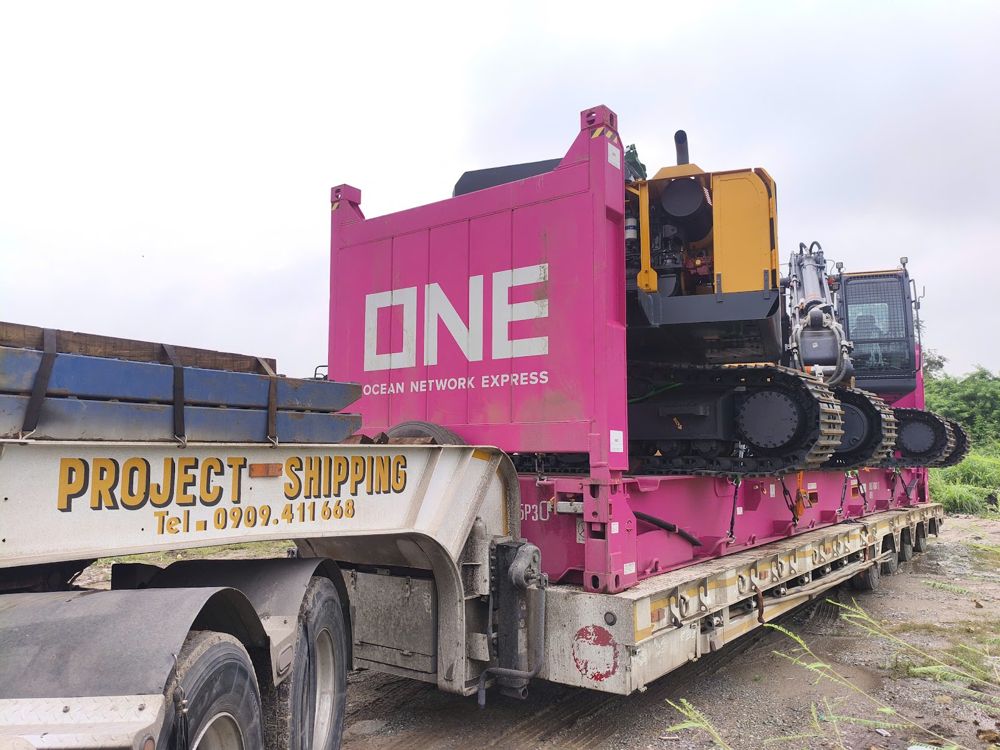
Ro-Ro and car carrier calls in Vietnam concentrate on two gateways. Which terminal a sailing uses depends on the line and the rotation, so we confirm it at booking.
Terminal by terminal notes, UN/LOCODEs and gate rules are in our Vietnam ports guide. If the unit cannot be driven on the road after discharge, it goes onto one of our lowbeds; see heavy haulage in Vietnam for permits and trailer limits.
The paperwork depends on whether the unit is a vehicle, machinery, or project equipment entering temporarily. These are the points that cause delays most often.
| Item | What it means | Who prepares |
|---|---|---|
| Commercial invoice and packing list | Chassis or serial number for each unit, matching the bill of lading | Shipper |
| Bill of lading | One line per unit with dimensions and weight as measured | Line, via forwarder |
| Used machinery check | Vietnam limits imports of used machinery by age (Decision 18/2019/QĐ-TTg, generally up to 10 years) and may require inspection | Consignee, with our customs desk |
| Specialised inspection | Vehicles and some machinery need technical or quality inspection before release | Consignee and inspection body |
| Temporary import | Construction equipment brought in for one project and re-exported | Our licensed customs desk |
Send the year of manufacture and serial number of every used unit before booking. If a unit is over the age limit, it is far cheaper to find out before it sails than after it reaches the port.
The rules for export are simpler: an export declaration, commercial documents and, where a preferential duty applies at destination, a certificate of origin. Our export from Vietnam guide covers the steps.
Ro-Ro freight is usually charged per cubic metre or per freight ton (W/M), based on the unit’s measured length, width and height. Four things move the price most:
Measure the unit yourself rather than using catalogue figures. Lines re-measure at the terminal, and the difference is billed.
Recent Ro-Ro work through our desk, with the routes and dates from our job files:

We book Ro-Ro with K Line, NYK and MOL for trucks, construction machinery and rolling units across Asia and Australia.
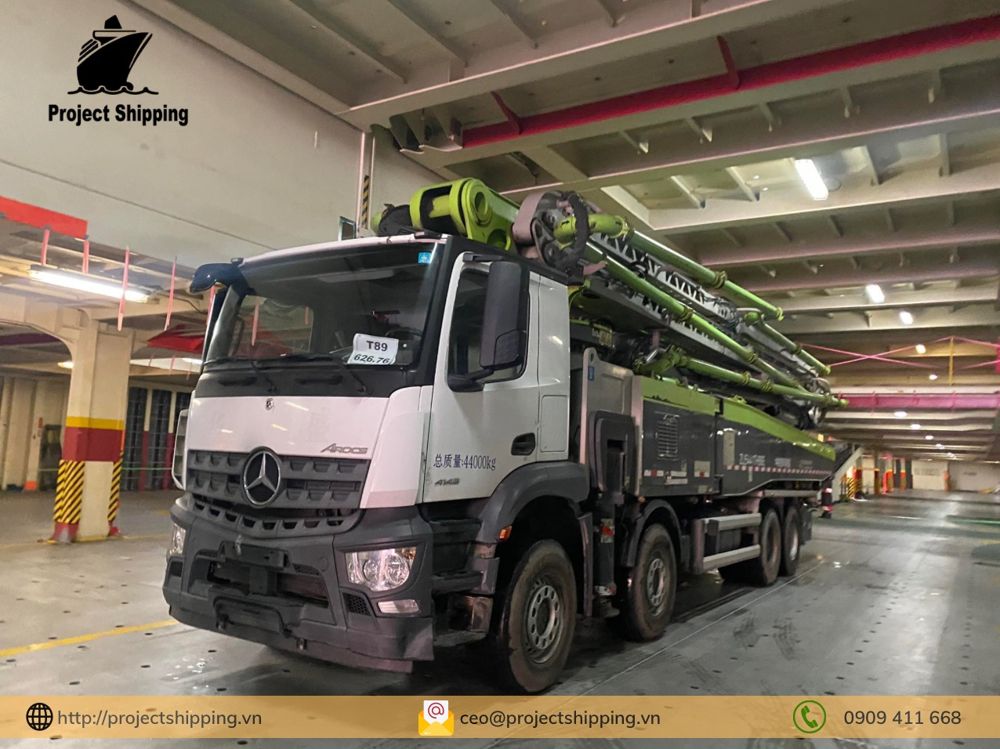
For an agent, the hard part of Ro-Ro is not the ocean leg; it is everything between the ramp and the site. In Vietnam we run that part from one desk:
For heavy lift and breakbulk options on the same shipment, see breakbulk, heavy lift and Ro-Ro in Vietnam.
Hook-to-truck discharge, Mafi lashing, customs and our own lowbeds.
Breakbulk service →Tony Tuan, CEO: WhatsApp +84 909 411 668 · ceo@projectshipping.vn
Nura Tu, Overseas Department: WhatsApp +84 906 770 650 · overseas@projectshipping.vn
Calling from Vietnam: 0909 411 668
Reference: Roll-on/roll-off (Wikipedia)
Last updated: October 2026 · By Tony Tuan, CEO, Project Shipping



© 2017 – 2025 Project Shipping. Design by Thiết kế Web DC