Insight · Equipment guide · Updated October 2026
A flat rack container gives you a strong floor and two end walls, nothing else. Here are the sizes and payloads that decide whether your cargo fits, and what changes once the rack is on a Vietnamese road.
Written by our OOG desk in Ho Chi Minh City. · Jump to the size table

The table shows typical ranges across the major container lines. Use it to screen your cargo, then check the exact flat rack container the line will release.
| Specification | 20′ flat rack | 40′ flat rack | 40′ high-cube flat rack |
|---|---|---|---|
| Inside length | about 5.5–5.7 m | about 11.6–12.1 m | about 11.6–12.1 m |
| Inside width (between stanchions) | about 2.2–2.4 m | about 2.2–2.4 m | about 2.2–2.4 m |
| End-wall height above floor | about 2.2–2.3 m | about 1.9–2.0 m | about 2.2–2.3 m |
| Floor (deck) height | about 0.35–0.40 m | about 0.60–0.65 m | about 0.60–0.65 m |
| Tare weight | about 2.5–3.2 t | about 4.5–6.2 t | about 5.0–6.3 t |
| Payload | about 28–35 t | about 39–45 t | about 40 t, heavy-duty up to about 50 t |
The international size and rating rules for freight containers are set in ISO 668. Each flat rack container also carries its own data plate with tare, payload and maximum gross weight; that plate is what the terminal and the line go by.
Width is the number most agents get wrong. The rack itself is 2.438 m wide outside, but over-width cargo can hang past the sides. Over-length cargo can pass the end walls when they are folded down.
There are two main designs of flat rack container, plus the platform. The choice affects loading, storage and how long your cargo can be.
| Design | How it works | Good for |
|---|---|---|
| Collapsible ends | End walls fold flat onto the floor; empty racks stack for return | Most cargo; long units that overhang the ends; empty repositioning at low cost |
| Fixed ends | End walls are welded in place | Heavy units that need strong end walls; fewer moving parts to check |
| Platform (no end walls) | A flat steel floor only | Very long or very wide pieces, often several platforms combined under one unit |
Most racks released at Vietnamese depots are collapsible. If your cargo needs fixed ends or a platform, say so at booking, because availability is lower.
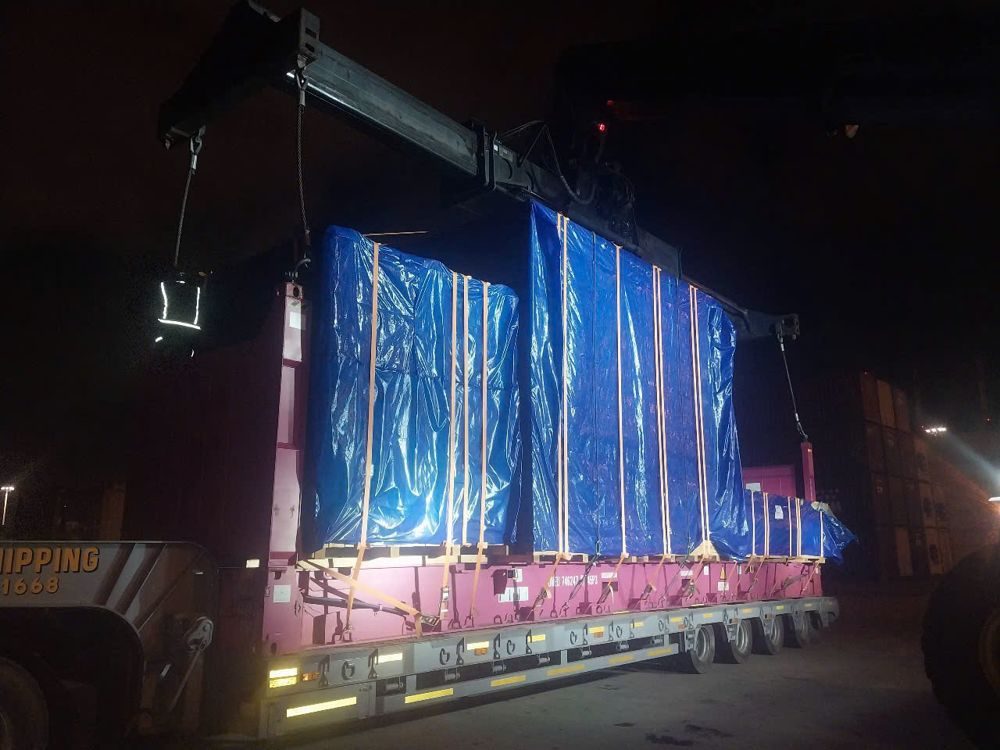
The end walls take the load when the vessel pitches or the truck brakes hard. Cargo is often lashed against them, or blocked with timber so it cannot slide.
When the walls are folded for over-length cargo, that support is gone. The lashing plan must then hold the unit on its own, with more lashings along the length.
At sea, height is limited only by what the line accepts as over-height. On the road in Vietnam, the limit is the loaded vehicle: 4.2 m, or 4.35 m for container vehicles, before a permit is needed.
Add three heights to check: the trailer deck, the rack floor and the cargo itself.
In practice, cargo taller than about 2.4 m on a 40′ flat rack usually takes the truck over 4.35 m on a standard chassis. A lowbed carries the rack lower and often keeps the move within limits, or within the permit we already hold. Our OOG cargo service page explains how we plan that road leg.
The payload on the data plate of a flat rack container assumes the weight is spread over the floor. A heavy unit standing on four small feet can overload the floor even when it is far below the payload.

Most damage on a rack happens in the first hour: at lifting, at lashing, or on the first bend out of the depot. These are the checks our lashing team runs on every flat rack container.
The final outline matters. The line approves the packed size, so we measure again after lashing and send the figures to you before the truck leaves.
An FR is not always the answer. Pick the equipment by the shape of the cargo first, then by cost.
| Your cargo | Best option | Why |
|---|---|---|
| Too tall only, fits in width | Open top | Side walls protect the cargo; usually cheaper than an FR. See our open top container guide. |
| Too wide, or must load from the side | Flat rack | No side walls; crane or forklift can reach the cargo |
| Longer than about 12 m | Flat rack with ends folded, or platforms | Overhang is possible within the line’s acceptance |
| Wider than about 4 m, or heavier than the rack payload | Breakbulk | Stowed in the hold or on deck without a container. See what is breakbulk cargo. |
| Self-propelled: trucks, cranes, excavators that drive | Ro-Ro or flat rack | Ro-Ro saves lifting; flat rack works on routes without Ro-Ro service |
Add the port and the pick-up or delivery address. Ocean options with OOG acceptance follow the same working day.
FR units move through Cat Lai, Cai Mep and Hai Phong, and through the river terminals of Ho Chi Minh City such as SPITC. A few local points save time.


Need the terminal list and port codes? See our Vietnam ports guide. For units that go straight from vessel to site, see project cargo in Vietnam.
Flat rack and open top handling through Cat Lai, Cai Mep and Hai Phong.
OOG service →Tony Tuan, CEO: WhatsApp +84 909 411 668 · ceo@projectshipping.vn
Nura Tu, Overseas Department: WhatsApp +84 906 770 650 · overseas@projectshipping.vn
Calling from Vietnam: 0909 411 668
Last updated: October 2026 · By Tony Tuan, CEO, Project Shipping · Vietnamese version



© 2017 – 2025 Project Shipping. Design by Thiết kế Web DC