Guide · New and used machinery · HS code · Inspection · Duty · Oversize delivery
A vessel that slips past New Year can make a used machine too old to clear. To import machinery to Vietnam without that kind of surprise, settle age, HS code and truck before you pay the supplier.
For factory owners, EPC contractors and freight agents. · See the age limit table by HS heading
Short answer: to import machinery to Vietnam, a Vietnamese company acts as importer, classifies the machine by HS code, checks the policy on that code, then files a customs declaration and pays duty and VAT. New machines mostly stop there. Used machines also need proof of age and standards before customs will clear them.
Built from our customs and trucking files and the current legal text in the original Vietnamese. Below: age limits by machine group, what changed in September 2026, and five costly mistakes.
Steps 1 to 5 happen before the machine leaves its factory or yard. That is when a problem is still cheap to fix.
For the filing itself (document checklist, channels, timeline), see our customs clearance guide for machinery. This page covers the decisions that come first.
The same customs system handles both, but the used file carries one extra test that can stop the shipment outright.
| Question | New machine | Used machine (HS chapters 84 and 85) |
|---|---|---|
| Who can import | Any eligible Vietnamese importer | An enterprise, for direct use in its own production in Vietnam |
| Age limit | None | 10 years as a rule, 15 or 20 years for listed groups |
| Extra proof | Only what the HS line requires | Manufacturer’s letter or an inspection certificate |
| On the declaration | Stated as new | Stated as used, never as “100% new” |
The working text is Circular 56/2026/TT-BKHCN from the Ministry of Science and Technology, in force since 5 September 2026. Older guides quote Decision 18/2019. The new circular keeps that decision for transition cases, such as certificates issued before that date.
| Machine group | HS heading | Maximum age |
|---|---|---|
| General rule, not listed below (example: excavators, 84.29) | Chapters 84 and 85 | 10 years |
| Metal forming and casting: converters and casting machines, rolling mills | 84.54, 84.55 | 20 years |
| Metalworking machine tools: laser and waterjet, machining centers, lathes, drilling and milling, grinding, presses | 84.56 to 84.63 | 20 years |
| Calendering and rolling machines, except for metal or glass | 84.20 | 20 years |
| Mechanical machines with individual functions, not specified elsewhere | 84.79 | 20 years |
| Woodworking machine tools; board presses | 84.65, 84.79.30.00 | 20 years |
| Paper and pulp machinery | 84.39, 84.40, 84.41 | 20 years |
| Other equipment for wood, pulp, paper or board | 84.19.35 | 15 years |
Condensed from Appendix I of the circular. Always match the full 8-digit line and description against the original text.
Age is simple arithmetic: year of import minus year of manufacture, in whole years. The year of import is the year the goods reach the Vietnamese border, not the year you sign or sail.
Age is only half of the test. The machine must also meet Vietnamese technical regulations (QCVN) on safety, energy saving and environment. Where no QCVN applies, it must follow TCVN or a national standard of a G7 country or Korea.
The circular allows used machinery only when it directly serves the importing enterprise’s production in Vietnam. A dealer bringing in used excavators as stock for resale does not fit that wording easily. If that is your plan, ask before you buy, not after the machine is on the water.
On top of the normal import file, the proof depends on where the machine was made.
| Made in | Accepted proof | Watch out for |
|---|---|---|
| G7 country or Korea | Original manufacturer’s letter on year of manufacture and production standard, or an inspection certificate | The letter needs consular legalization and a Vietnamese translation, which takes time |
| Anywhere else (China, for example) | Inspection certificate from a designated inspection body | It must conclude that the machine meets the import criteria |
| Any origin, proof not ready at filing | Register for inspection and move the machine to storage under customs rules | Certificate due to customs within 30 days of entering storage |
An inspection certificate for a used machine is valid for at most 6 months, counted from its issue date to arrival at the Vietnamese border. Inspect too early and a slow shipment can outlive the paper. A failed result brings an administrative penalty, and the machine stays in storage while costs keep running.
There is one route, and it is narrow. An enterprise already producing in Vietnam can apply to the Ministry of Science and Technology to keep that production running. Remaining capacity or efficiency must be at least 85% of design, and material and energy use no more than 15% above design.
On paper the ministry takes about 10 working days after a complete file: 2 to send it out, 5 for other ministries’ opinions, 3 to reply. Plan for longer. A new buyer with no plant running in Vietnam does not qualify.
Send a nameplate photo, serial number, model and country of manufacture. We tell you which test applies and which papers customs will ask for.
Before you import machinery to Vietnam, start from what the machine does, then read the chapter and section notes. The supplier’s code is a hint. Vietnam’s 8-digit line can differ from the code on an export invoice, and that line sets both the duty and the policy.
| Machine | Usual heading to start from | What decides the final line |
|---|---|---|
| Excavators, loaders, bulldozers | 84.29 | Self-propelled or not, 360° revolving superstructure, capacity |
| Cranes and lifting frames | 84.26 | Type, mobile or fixed, lifting capacity |
| CNC machining centers, lathes | 84.57, 84.58 | Metal removal, number of axes, numerical control |
| Power transformers | 85.04 | Liquid or dry type, power rating in kVA |
These headings are starting points, not a ruling. When a machine could fit two codes, the head of our customs desk decides.
Large machines often arrive in many packages. Vietnam has a procedure for combined machines and functional units in chapters 84, 85 and 90, and for machinery shipped unassembled or disassembled. Updated under Circular 85/2026/TT-BTC from 15 September 2026, it requires a list to be registered before the first import declaration.
Customs confirms the list within 3 working days, then deducts each shipment against it. Skip it, and each package can be classified on its own, at a different code and duty rate. Your packing list should also show which package belongs to which machine.
Often no, sometimes yes, and the HS line tells you where to look. A code with a policy note leads to a legal text, and that text must match your machine’s description and use, not only its code.
Import duty depends on the 8-digit HS line, the origin and whether a valid certificate of origin (C/O) applies. Do not assume machinery is duty-free: rates differ from line to line, so we check yours.
VAT is charged on customs value plus duty. The general rate is 10%, with a temporary cut to 8% on many goods through 31 December 2026 and listed exclusions. DFDL’s summary covers the extension. Check your line before you budget.
| Arithmetic example (assumed rates) | USD |
|---|---|
| Customs value (CIF) | 200,000 |
| Import duty at an assumed 3% | 6,000 |
| VAT at an assumed 8% on 206,000 | 16,480 |
| Total paid at the border | 22,480 |
This shows the method only. Real rates come from your HS line and declaration date.
Every plan to import machinery to Vietnam ends on a road. Two enquiries on our desk in 2026 show why dimensions come first. Both were used excavators bound for Cat Lai on a 40′ flat rack. Figures are rounded.
| Enquiry A | Enquiry B | |
|---|---|---|
| L × W × H | About 11.2 × 3.3 × 3.5 m | About 11.9 × 3.4 × 3.6 m |
| Gross weight | About 32 t | About 48 t |
| On a 40′ flat rack | Within payload, about 39 to 45 t | Over the usual payload, needs a heavy-duty unit or Ro-Ro or breakbulk |
| Length | Fits a floor of about 11.6 to 12.1 m | Very tight, end walls folded and carrier approval needed |
| First question on any used machine | Year and serial number | Year and serial number: this model line may be over 10 years old |
These are enquiries, not delivered jobs. We show them for the questions they raise. The next section lists handled files.
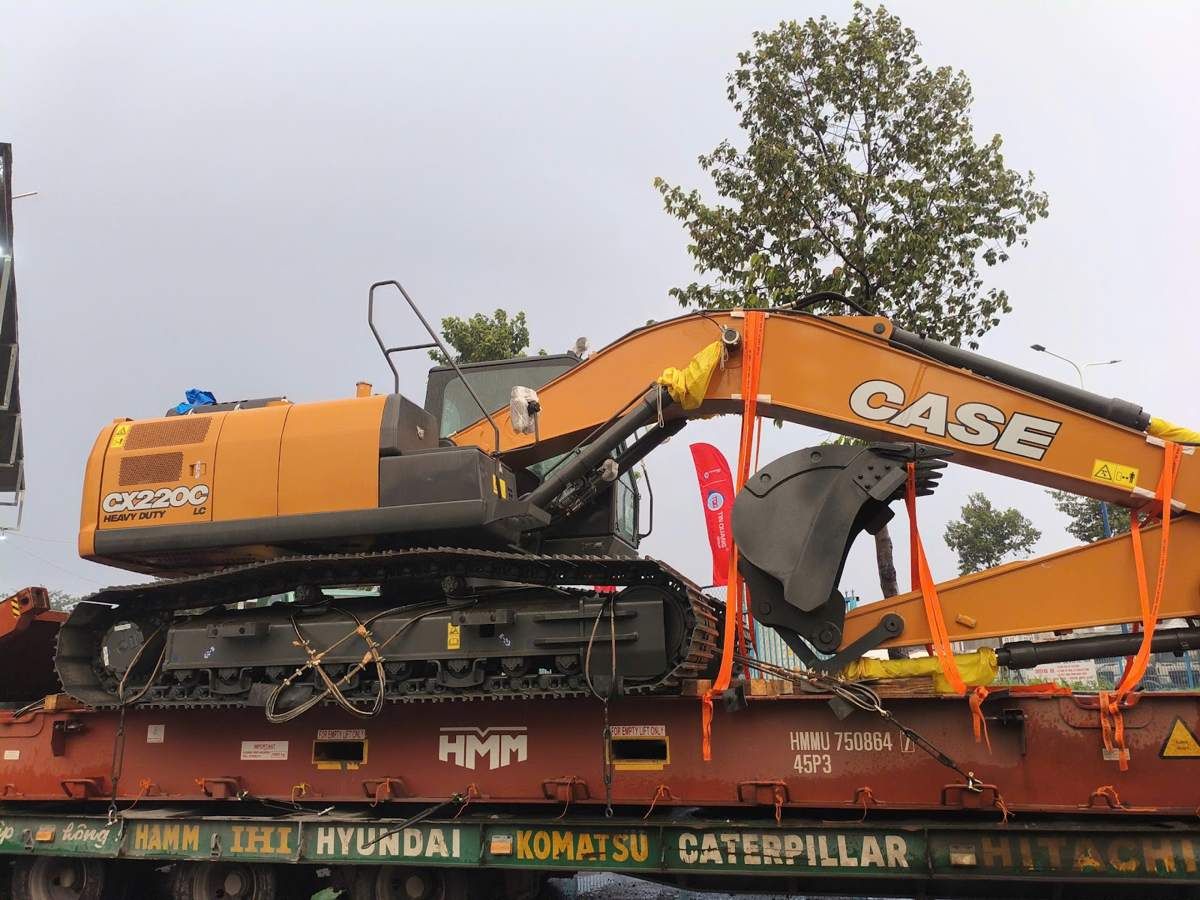
Width and height on the rack also set the road plan. A 3.4 m wide machine needs a permit, a route check and a lowbed booked for the day of release. See flat rack dimensions for the full size table.
Which port? Northern sites usually use Hai Phong or Lach Huyen. Factories around Ho Chi Minh City usually use Cat Lai for flat racks and open tops. Breakbulk and heavy lifts in the south usually go through Cai Mep–Thi Vai.
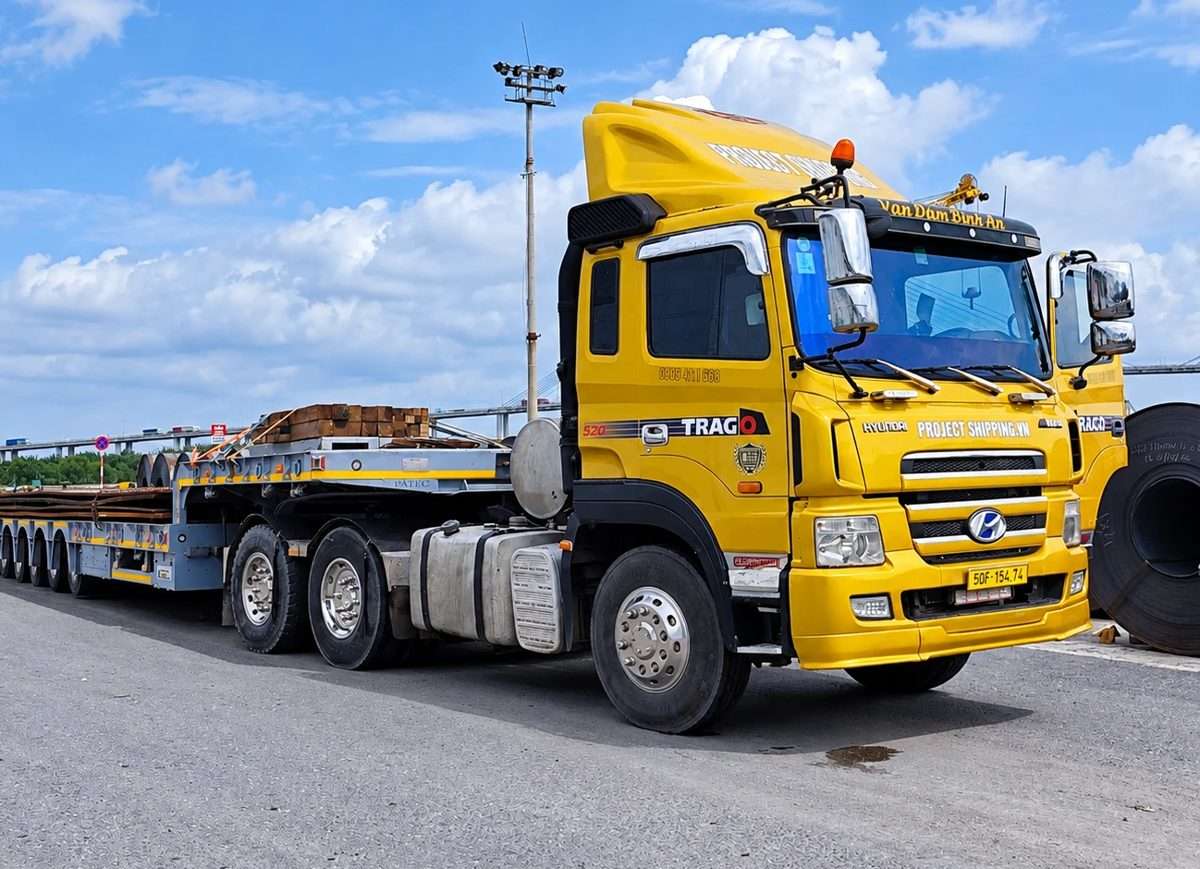
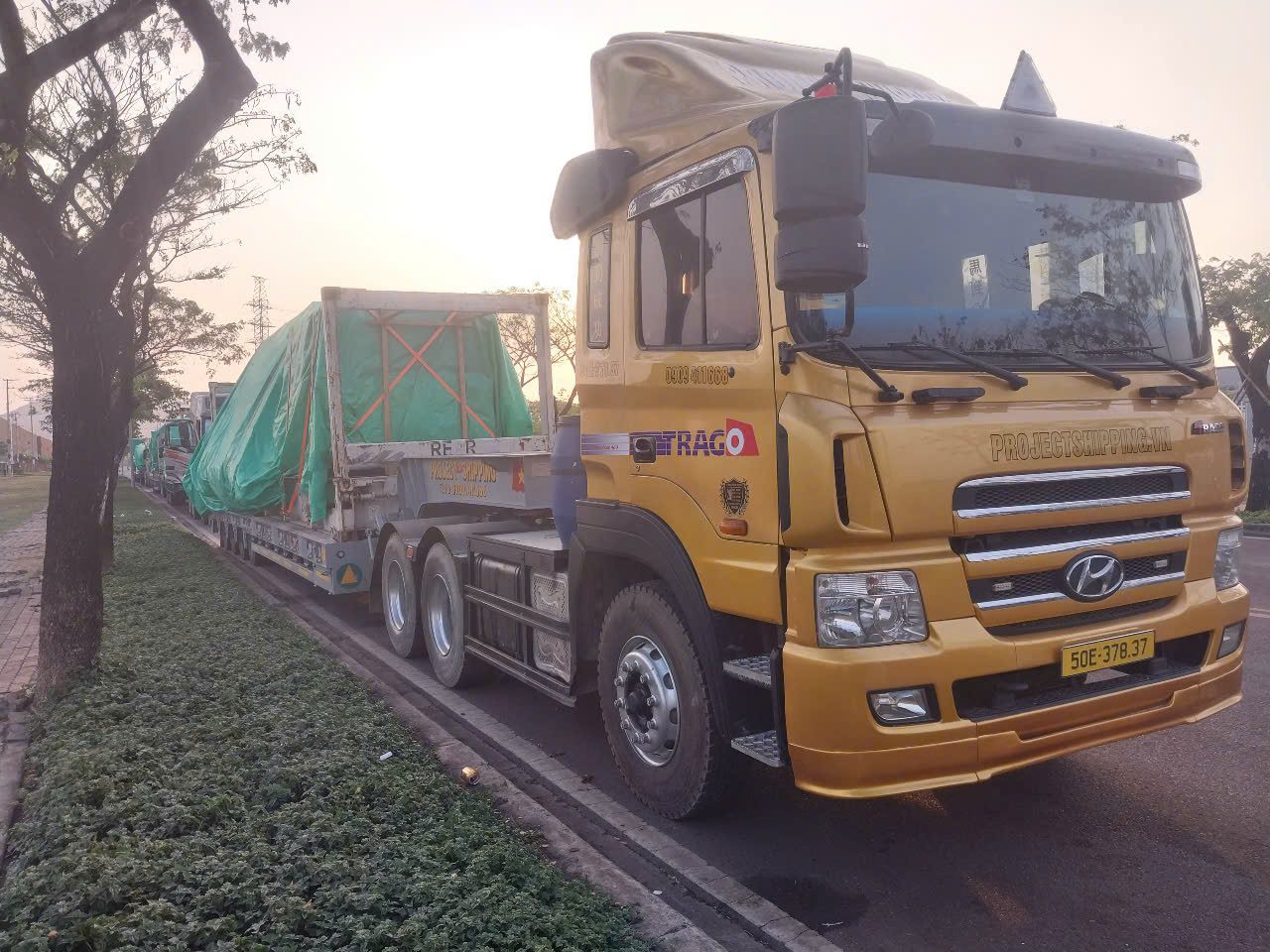
Our own fleet is 2 four-axle lowbeds and a 6-axle unit with a 14.5 m deck, 3.2 m width and 62 t payload. Our trucks hold a standing permit for many flat rack moves, and a new road permit takes about 2 working days once documents are complete. Mobile cranes and SPMT are arranged through partners, and we include them in one plan.
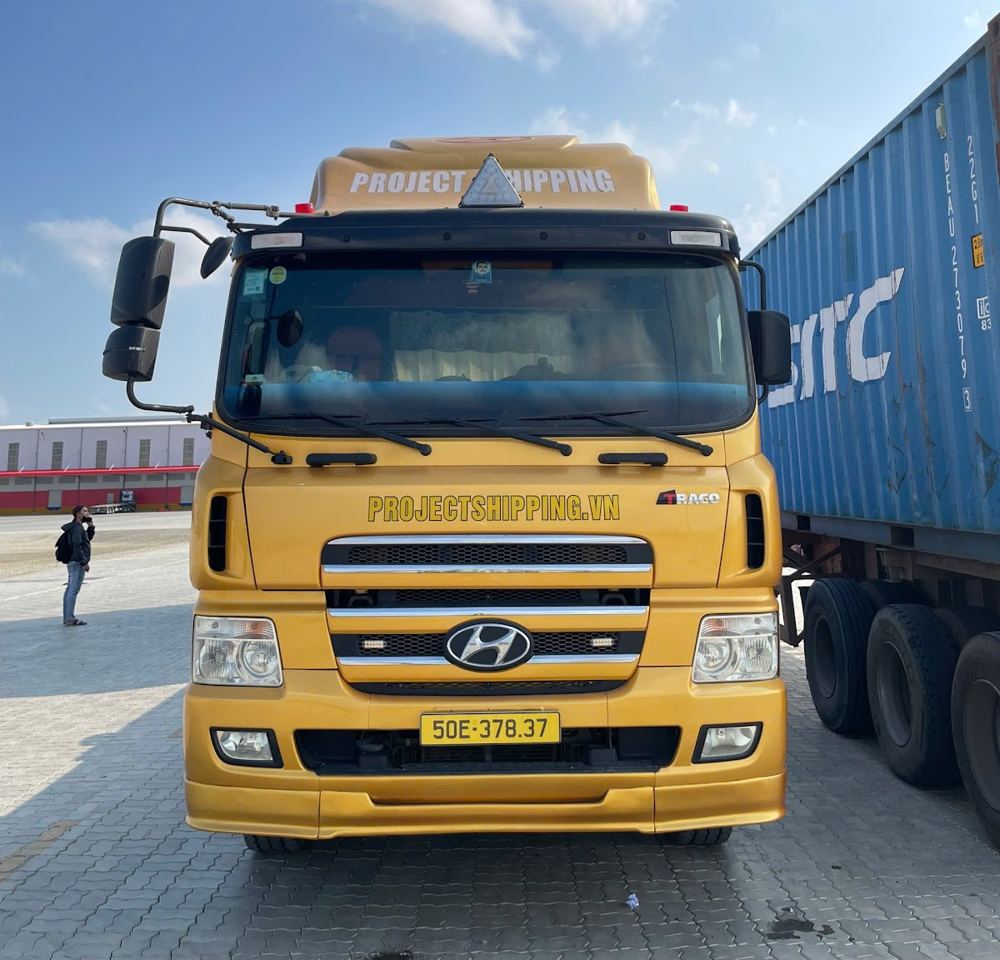
Customer names are removed. Cargo, route and date are as filed in our job folders.
| Cargo | Equipment | Route | Date |
|---|---|---|---|
| Excavators | 2 × 40′ FR | Cat Lai → My Phuoc–Tan Van | Oct 2026 |
| Excavators | 4 × 40′ FR | TCIT terminal → My Phuoc–Tan Van | Aug 2026 |
| Excavators | 2 × 40′ FR | Cat Lai → My Phuoc–Tan Van | Jul 2026 |
| Plant equipment | 12 × 40′ FR under tarpaulin | Cat Lai → Phu My | Mar 2026 |
| Hitachi Zaxis 200 excavator | Flat rack, lowbed | Cat Lai → Thu Duc | Mar 2024 |
| Machinery, trucking and devanning | 2 × FR | Cat Lai → Duc Hoa Industrial Park | Nov 2023 |
| Annealing machines | 2 × FR | Cat Lai → Duc Hoa Industrial Park | Oct 2023 |
| Excavator, customs and trucking | Flat rack, lowbed | Cat Lai → Suoi Tien | Oct 2023 |
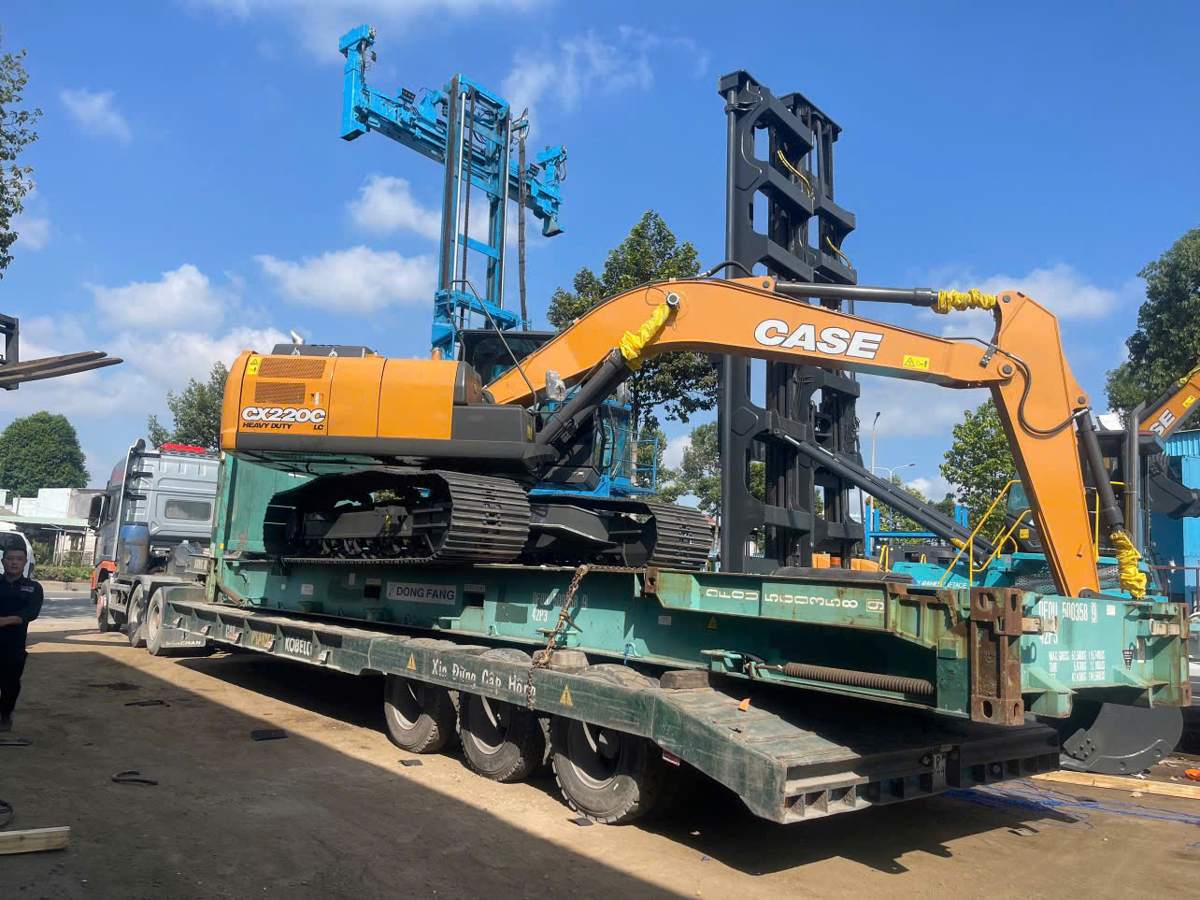
Heavy pieces also need a lifting plan and ground that can carry the crane. We photograph pick-up, lashing and delivery, and send the photos to you.
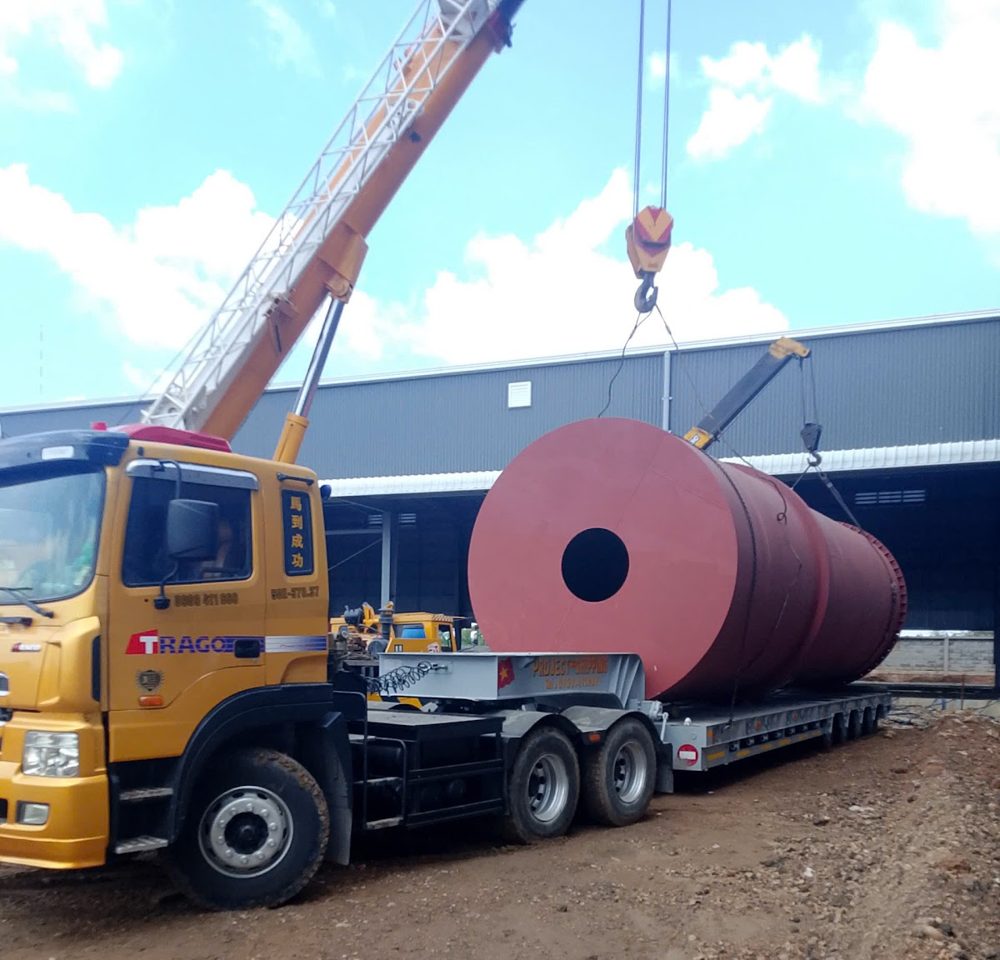
The machine and ocean freight are the visible costs. Here is what else to budget when you import machinery to Vietnam.
| Item | How it is charged | Our note |
|---|---|---|
| Customs service | From VND 1,200,000 per container | Yellow and red channels add a surcharge; lifting or unstuffing the officer requires is extra. Our fees exclude 10% VAT |
| Flat rack or open top supervision at Cat Lai | VND 3,000,000 per container | Applies when we clear the cargo, in or out of gauge |
| Used-machine inspection | Quoted by the inspection body | Excluded from our quotes unless stated, along with storage while waiting |
| Local charges | THC, D/O and more, by carrier | See our local charges tables |
| Trucking, permit, crane | Quoted per job from dimensions and route | See heavy haulage in Vietnam |
Who qualifies, the exemption list, split shipments and import VAT for fixed-asset imports.
Duty exemption guide →8-digit lines for Chapters 84 and 85, with real duty rates and common mistakes.
HS code guide →Document checklist, green, yellow and red channels, timeline and fees.
Customs guide →Real Busan transit days and C/O forms for heavy machinery.
Korea to Vietnam →Import machinery to Vietnam from Japan: real Kobe excavator files and age limits.
Japan to Vietnam →Send L×W×H, weight, model, year, nameplate photo and site. Freight agents: see how we work with agents.
Tony Tuan, CEO: WhatsApp +84 909 411 668 · ceo@projectshipping.vn
Nura Tu, Overseas Department: WhatsApp +84 906 770 650 · overseas@projectshipping.vn
Calling from Vietnam: 0909 411 668
Last updated: November 2026





© 2017 – 2026 Project Shipping. Design by Thiết kế Web DC